

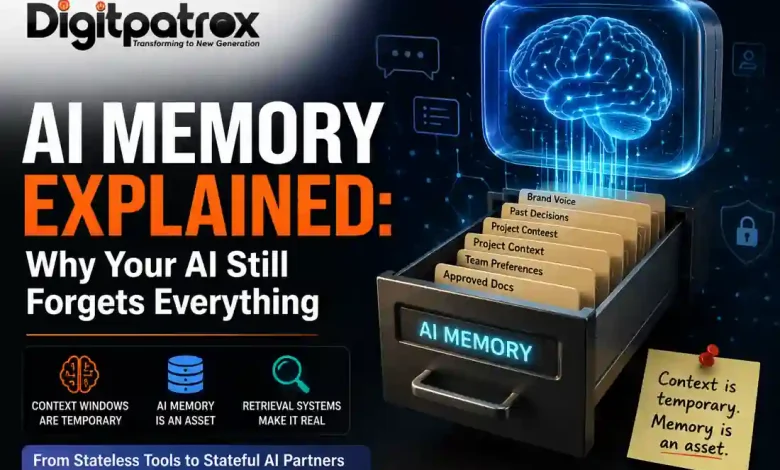
AI Memory vs Context Windows: Why Your AI Still Forgets Everything
Most AI still forgets everything the moment the chat ends. You spend all morning explaining a project, and by Friday, you’re starting from zero. It’s a “goldfish problem” that creates massive repetitive work—the constant, manual labor of re-briefing a machine that should already know better. In 2026, the real AI race isn’t about model size; it’s about building a system that remembers.
We are moving from “Stateless” tools to Stateful partners. This changes the machine from a chatbot you visit into a persistent collaborator that lives alongside your team.
In plain English:
-
Context windows are temporary “working memory.” They expire.
-
Long-term AI memory is a permanent asset. It compounds.
-
Retrieval systems act as the “eyes” that decide what the “brain” actually remembers right now.
The TL;DR for Executives
-
Stop chasing bigger models: A 1-million token context window isn’t “memory”—it’s just a big, messy desk.
-
The Goldfish Problem: Most AI tools today are stateless. They forget your brand voice and past decisions the moment the session ends.
-
The weird part? Good memory systems forget aggressively. Without a way to prune old drafts and abandoned ideas, the AI’s accuracy collapses under the weight of its own history.
-
Operational Reality: The most successful AI deployments aren’t about buying “smarter” models; they are about document hygiene and retrieval quality.
The Assistant’s Briefcase: How Memory Actually Works
The funny thing is, the AI model doesn’t actually “remember” anything in the way humans do. Instead, a secondary retrieval system decides what the model sees by ranking and injecting relevant history into the prompt.
Think of it like an assistant with a briefcase. Stateless AI shreds its notes every single night. Stateful AI keeps the briefcase, indexes the pages, and pulls out the exact document you need before you even ask.
One engineer described it to me as “watching the AI develop office politics”—the system kept resurfacing old internal debates that had been settled months earlier because the retrieval layer couldn’t distinguish between a brainstorm and a final decision. You don’t need a bigger desk; you need a better filing cabinet.
Why 1M Token Context Windows Don’t Solve This
A lot of people think 1-million-token context windows (like Claude or Gemini) solve the memory problem. They don’t. When you stuff an AI’s window with six months of history, you create noise. The model starts to get buried in it—it misses the most important fact because it’s buried under 500 pages of irrelevant chat logs.
You Eventually Have to Pick Your Headache
Every memory system forces a trade-off. You can’t have infinite history, perfect accuracy, and instant responses all at once. You have to decide which technical “scar” your workflow can handle.
| The Choice | The Benefit | The Hidden Cost |
| Deep Personalization | AI knows your specific style. | Latency: Every answer takes 8-10 seconds to “search.” |
| High Reliability | It rarely makes mistakes. | Noise: The AI gets confused by similar but old docs. |
| Multi-Year Persistence | Years of context. | Contamination: Old errors become permanent “facts.” |
Eight seconds of latency doesn’t sound terrible until you’re using the system 300 times a day. Then the whole workflow starts feeling heavy.
The Part Nobody Thinks About: Forgetting
Weirdly, the best memory systems usually forget a lot. If an AI remembers every single Slack message, random thought, and “draft” version of a document, its intelligence actually drops. High-quality memory requires Recency Weighting—newer decisions should usually override old ones.
In some companies, half the deployment timeline gets consumed just cleaning duplicate PDFs and conflicting documentation before the AI ever goes live. A surprising amount of enterprise AI work is basically document hygiene. Nobody expects that part at the beginning.
Some teams solve this by using reranking layers from tools like Cohere, while others manually tag “approved” documents before they ever enter the vector database.
The Messy Reality of Enterprise Memory
Enterprise memory is a different category entirely. Most serious deployments end up stitching together multiple systems: vector databases, rerankers, permission layers, orchestration frameworks, internal documentation, and Slack history.
It gets messy fast. Especially once multiple departments start feeding documents into the same retrieval layer.
And honestly, that messiness is part of the challenge. A lot of AI memory problems are really data organization problems wearing an AI costume. If your system doesn’t respect Permission Inheritance, you have a massive AI cybersecurity risk. An intern using AI for productivity could accidentally “retrieve” sensitive payroll data just because it’s semantically similar to a query about salary structures.
How It Looks as You Scale
-
Level 1 (Stateless): You re-explain everything every time.
-
Level 2 (Session Persistent): It remembers the current chat, but nothing else.
-
Level 3 (Retrieval-Augmented): It pulls from your RAG-based textbook.
-
Level 4 (Cross-App Memory): It uses the Model Context Protocol (MCP) to remember across apps.
-
Level 5 (Stateful Partner): It self-corrects, prunes old data, and acts as a source of truth.
Conclusion: Memory is an Asset
Model quality still matters, obviously. But memory quality is becoming the bigger operational advantage. After a while, teams stop caring about whether the model is “smart.” They care about whether it remembers the right things without creating more noise. That’s the real shift happening right now.
We are moving from AI browsers that just find info to Stateful Systems that manage it. Stop re-explaining your business every Monday.
Most teams eventually realize the problem isn’t that the AI is dumb. It’s that the memory layer was never designed properly in the first place.
Context is temporary. Memory is an asset.
SEO & Metadata
-
Title: AI Memory vs Context Windows: Why Your AI Still Forgets Everything
-
Meta Description: AI still forgets critical context. Learn why context windows fail, how AI memory systems actually work, and what companies are building instead.
-
Slug: /ai-memory-systems-explained-context-vs-memory/
-
Focus Keyphrase: AI Memory Systems
-
Tags: AI Memory, RAG, Vector Databases, Stateful AI, MCP, Enterprise AI, Context Window.
FAQ
-
What is the difference between AI memory and a context window? A context window is temporary “working memory” used within a single chat session. AI memory is a persistent database that stores and retrieves information across multiple sessions and tools.
-
What is a stateful AI system? A stateful AI is a system that retains information, preferences, and past decisions over time, allowing it to act as a long-term collaborator rather than a one-off tool.
-
Why do large context windows sometimes fail? Large windows can suffer from “noise” and “Lost in the Middle” syndrome, where the AI misses critical facts because it is overwhelmed by irrelevant information.
-
How do I give an AI long-term memory? By using a RAG (Retrieval-Augmented Generation) architecture and a Vector Database (like Pinecone or pgvector) to store and retrieve specific facts as needed.
Most teams eventually realize the problem isn’t that the AI is dumb. It’s that the memory layer was never designed properly in the first place.
The companies that figure out retrieval, memory quality, and clean context first will have the real advantage. Context is temporary. Memory is an asset.
